introduction: Reliability When It Matters Most
Industrial facilities rarely operate in controlled, comfortable conditions. Oil fields experience scorching desert heat. Offshore platforms endure high winds, salt spray, and brutal humidity. Chemical plants face corrosive vapors, particulate dust, and extreme temperature swings. In these environments, detection equipment must perform flawlessly – because the risks of failure can be catastrophic.
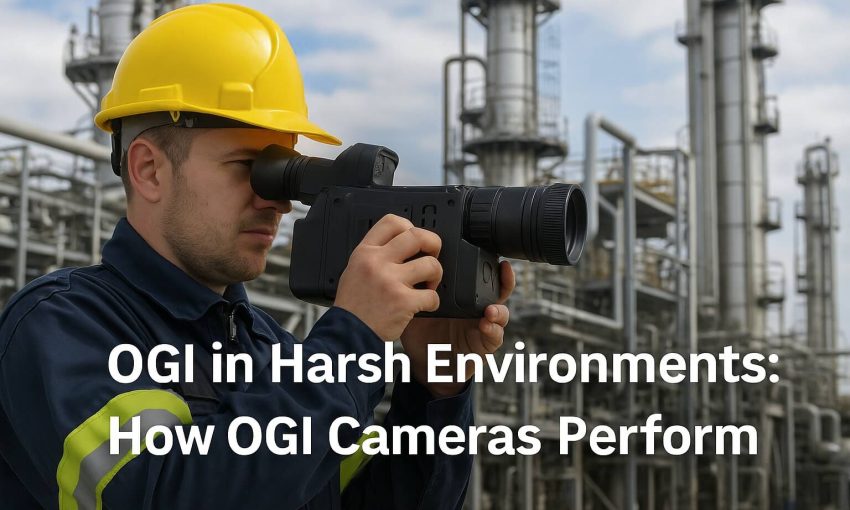
This is precisely why optical gas imaging (OGI) technology has become an essential tool in modern industrial safety. An OGI camera is not just a visual device; it is a highly engineered optical instrument designed to withstand environmental extremes while identifying hazards that would otherwise remain invisible.
When operating in harsh conditions, robustness, calibration stability, and imaging reliability determine whether leaks are detected early – or missed entirely. In this article, we explore how OGI systems are built, tested, and optimized to perform under extreme pressure, making them the gold standard in environments where accuracy and durability are non-negotiable.
Why Harsh Environments Challenge Gas Detection Technologies
Industrial sites expose equipment to conditions that can degrade performance or cause total failure. Some of the most challenging factors include:
1. Extreme Temperatures
Oil and gas assets may be located in:
- Arctic regions as low as –40°C
- Desert environments exceeding +55°C
- Facilities with high ambient heat from compressors, furnaces, or flares
Traditional sensors drift, degrade, or malfunction under these extremes. But optical gas imaging systems use materials, lenses, and detectors specifically engineered to maintain optical clarity and calibration stability.
2. High Humidity and Condensation
On offshore platforms or coastal refineries, moisture can fog lenses, corrode electronics, or interfere with image clarity. OGI cameras are often sealed with specialized moisture barriers and purged housings to ensure clear imaging even when humidity reaches 95%+.
3. Dust, Sand, and Particulates
Mining operations, shale fields, and petrochemical plants often contain airborne particulates that can scratch lenses or reduce visibility. OGI cameras frequently include:
- Hardened protective windows
- Anti-scratch optical coatings
- Air-knife or blower systems to keep lenses clear
4. Corrosive or Chemical Vapors
Acid gases, solvents, and industrial chemicals can degrade conventional sensors.
Optical gas detectors using longwave infrared imaging avoid direct contact with gases and operate remotely, reducing exposure and increasing longevity.
5. Mechanical Shock and Vibration
Fixed OGI systems installed near compressors or rotating equipment must withstand constant vibration. Ruggedized housings, reinforced detector mounts, and vibration-isolated optics ensure stable imaging and long-term calibration integrity.
How OGI Cameras Are Engineered for Harsh Environments
To perform reliably in extreme industrial conditions, OGI systems incorporate advanced engineering principles that go far beyond consumer-grade optics or thermal imaging.
1. Ruggedized Optical Design
Unlike standard cameras, OGI systems use:
- High-durability infrared lenses made of germanium or zinc selenide
- Protective window materials to prevent scratching and chemical damage
- Sealed optical assemblies designed to prevent dust or moisture intrusion
These features ensure optical clarity even during abrasive or wet conditions.
2. Advanced Detector Cooling & Thermal Control
OGI cameras often rely on cooled detectors to achieve high sensitivity. These detectors must maintain stable cryogenic temperatures regardless of the external environment.
They use:
- Thermoelectric cooling modules
- Heat sinks for desert or high-heat environments
- Internal thermal insulation layers
This ensures consistent performance from the Arctic to the desert.
3. Weatherproof and Explosion-Proof Housings
For fixed-mount OGI systems, housings may include:
- IP66/IP67 protection against dust and water
- ATEX or UL hazardous-area certification
- Salt-fog resistant materials for offshore platforms
- Heaters and defoggers for cold or humid operations
This makes OGI systems suitable for Class I Div I zones and other hazardous industrial settings.
4. Onboard Calibration and Real-Time Compensation
Temperature swings or pressure changes can impact imaging detectors.
To counter this, modern OGI cameras use:
- Automatic non-uniformity correction (NUC)
- Adaptive gain control
- Real-time thermal drift compensation
- Dynamic background filtering
These features ensure that gas plumes remain visible even when the environment is unstable.
5. Remote Operation in Dangerous Conditions
In many harsh environments, human inspection is unsafe.
OGI systems support:
- Remote pan-tilt-zoom controls
- Automated scanning routines
- Integration with drones
- Real-time video streaming to control rooms
This allows operators to detect gas emissions from safe distances.
Use Cases: OGI Performance Under Pressure
Offshore Oil & Gas Platforms
Salt spray, corrosive vapors, and violent winds challenge nearly every type of sensor – except OGI.
OGI cameras operate at height, on moving structures, during storms, and in high humidity while still producing reliable imagery.
Desert Shale Operations
Dust storms and extreme heat can cause conventional sensors to drift.
Rugged optical gas imaging systems maintain stable calibration and clear visuals even when ambient temperatures exceed 50°C.
Petrochemical Plants & Refineries
These sites often contain:
- Highly corrosive chemicals
- High-pressure systems
- Frequent temperature fluctuations
- Vapor clouds invisible to the human eye
OGI systems detect VOCs and hydrocarbons without direct exposure.
Cold-Climate Pipelines
In freezing Arctic environments, frost and condensation can interfere with standard inspection tools.
OGI cameras equipped with heating elements and anti-fog coating continue to operate efficiently at sub-zero temperatures.
Mining & Industrial Manufacturing
Dust-laden environments reduce visibility and contaminate sensors.
OGI systems with hardened optical windows and air-blade cleaning mechanisms maintain clear, consistent imaging.
Why Optical Gas Imaging Excels Where Other Technologies Fail
1. Remote, Non-Contact Detection
Sensors that require direct contact struggle in extreme conditions.
OGI works from a distance – no contamination, no corrosion, no failure from gas exposure.
2. Real-Time Visual Confirmation
Instead of relying on numerical readings, operators see a real image of the gas plume, even in difficult environments.
3. Wide-Area Coverage
One OGI camera can inspect hundreds of components from a single vantage point, especially useful in places where access is limited or hazardous.
4. Higher Sensitivity for VOCs and Hydrocarbons
Where acoustic or electrochemical sensors struggle, optical gas detectors excel in identifying small leaks.
5. Superior Durability and Uptime
Designed specifically for industrial extremes, OGI systems offer long operational life, stable calibration, and fewer failures under stress.
The Future: AI-Driven OGI for Extreme Environments
Advancements in artificial intelligence are transforming the way OGI handles harsh conditions.
Emerging features include:
- AI plume recognition in noisy or low-contrast environments
- Auto-diagnostics to detect calibration drift in real time
- Self-cleaning optical modules
- Predictive analytics to identify environmental risks
- Robotic inspection platforms equipped with OGI sensors
This fusion of rugged optics, smart data, and autonomous systems will define the next generation of industrial gas detection.
Built for the Toughest Conditions on Earth
From offshore rigs to frozen pipelines, optical gas imaging has become the most reliable and versatile method for detecting gas emissions in extreme environments.
An OGI camera isn’t just a leak detection tool – it’s a resilient, precision-engineered platform built to operate where other systems fail.
By combining durability, high sensitivity, real-time visualization, and advanced calibration features, OGI systems ensure operational safety, regulatory compliance, and environmental stewardship even in the harshest conditions on the planet.
In environments where failure is not an option, OGI remains the technology you can trust.