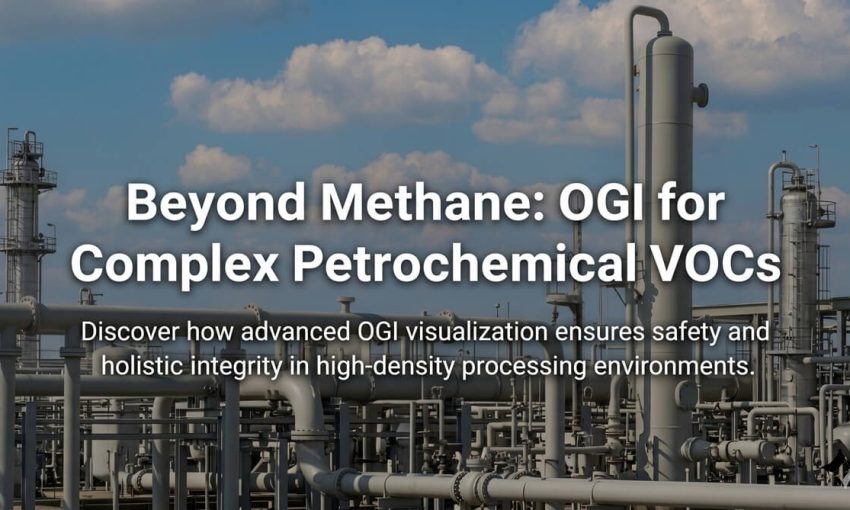
While the global regulatory conversation has been dominated by methane mitigation in the upstream sector, the downstream petrochemical and refining industries face a far more complex challenge. In these high-density environments, leak detection is not just about a single gas—it is about managing a cocktail of Volatile Organic Compounds (VOCs), aromatics, and heavy hydrocarbons. This article explores the expanding role of infrared camera to detect leaks in the downstream sector, analyzing how camera leak detection technology identifies failures in complex ch4 connections and VOC pipelines. By mastering multi-spectral detection, petrochemical facilities can move beyond simple compliance toward a state of holistic operational integrity.
The Downstream Complexity: More Than Just a Methane Problem
For much of the last decade, the oil and gas industry’s LDAR (Leak Detection and Repair) strategies were built around a singular objective: find and fix methane ($CH_4$) leaks. Driven by regulations like nsps ooooa and now oooob, the focus was squarely on the upstream and midstream assets where methane is the primary component.
However, as we move through 2026, the downstream sector—comprising refineries, chemical processing plants, and storage terminals—is undergoing its own technological transformation. In a refinery, methane is often just one of dozens of gases flowing through miles of interconnected piping. From benzene and butane to ethylene and propylene, the “gas landscape” of a petrochemical plant is vastly more diverse and hazardous than a typical well pad.
In this environment, a standard leak detection camera tuned only for methane is insufficient. The modern refinery requires a versatile infrared camera to detect leaks that can identify a broad range of hydrocarbons and VOCs, ensuring that safety, environmental compliance, and product recovery are managed through a single, high-efficiency workflow.
The Science of Multi-Spectral VOC Detection
To understand why specialized camera leak detection is necessary in petrochemical settings, we must look at the physics of infrared absorption. Every gas has a “spectral fingerprint”—a specific wavelength in the infrared spectrum where it absorbs energy.
The MWIR “Sweet Spot”
Most hydrocarbon gases, including methane and a wide array of VOCs, exhibit strong absorption in the Mid-Wave Infrared (MWIR) region, specifically between 3.2 and 3.4 micrometers. High-performance ogi systems are engineered with narrow-bandpass filters that allow the camera to “see” the energy imbalance created when these gases are present.
While methane is highly visible in this range, many other VOCs common in refineries also absorb energy here. A professional-grade infrared camera to detect leaks allows a technician to visualize leaks of:
- Alkanes: Ethane, Propane, Butane, Pentane, Hexane, Heptane, Octane.
- Aromatics: Benzene, Ethylbenzene, Toluene, Xylene (BTEX).
- Olefins: Ethylene, Propylene.
- Alcohols: Methanol, Ethanol.
This multi-gas capability is what makes OGI the ultimate tool for petrochemical LDAR. Instead of carrying multiple “sniffer” probes for different gas types, a single thermographer can scan an entire process unit and identify a leak, regardless of whether it is methane or a heavier hydrocarbon.
Managing Complex CH4 Connections in High-Density Environments
In a refinery, the sheer density of equipment is staggering. A single process unit may contain thousands of potential leak points—valves, flanges, pumps, and connectors—packed into a small physical footprint.
The Challenge of Secondary CH4 Connections
While methane may not be the primary product in a chemical plant, it is often present as a byproduct or a fuel source for high-temperature processes. CH4 connections in these facilities are often located in hard-to-reach areas: high overhead racks, within dense “pipe forests,” or inside complex heat exchanger assemblies.
Using legacy “Method 21” sniffer technology in these areas is notoriously slow and physically dangerous for technicians. Camera leak detection changes the safety dynamic entirely. An operator can scan hundreds of ch4 connections from a safe distance on the ground, utilizing the camera’s zoom and high-resolution sensor to identify the tell-tale “flicker” of a leak from a distance of 10 or 20 meters.
Visualizing the Invisible Danger
Many VOCs are not just environmental pollutants; they are highly toxic or explosive at low concentrations. In a refinery, a small leak at a high-pressure connection can quickly create a hazardous zone. The ability of an infrared camera to detect leaks to provide a real-time visual of the plume’s shape and direction is invaluable for safety. It allows operators to see exactly how a leak is dispersing—information that a numerical sniffer reading simply cannot provide.
Moving Beyond Compliance: The Economic Case for VOC Recovery
In the upstream sector, LDAR is often viewed through the lens of regulatory “avoidance”—avoiding fines and waste charges. In the downstream sector, the economic case for camera leak detection is even more direct: product recovery.
The High Cost of VOC Loss
Unlike methane, which is relatively inexpensive per unit of volume, many of the chemicals processed in refineries are high-value products. Every ton of ethylene or benzene lost to a leaking valve is direct revenue evaporating into the atmosphere.
By implementing frequent, high-resolution OGI surveys using advanced ogi technology, plants can identify “micro-leaks” before they escalate into major failures. This proactive maintenance approach significantly reduces “Unaccounted-for Gas” (UFG) and improves the overall yield of the facility. In 2026, where profit margins in the petrochemical sector are increasingly tight, the ROI of an infrared camera to detect leaks is often realized in months, not years, purely through product loss prevention.
Technical Standards: Why Sensitivity Matters in the Refinery
Not all OGI cameras are created equal, and in a petrochemical environment, technical specifications like NETD (Noise Equivalent Temperature Difference) are the difference between success and failure.
The Importance of <10mK Sensitivity
In many refinery areas, the thermal background is “noisy.” You have hot pipes, steam lines, and varying ambient temperatures. A low-sensitivity camera (with a high NETD) will struggle to distinguish a small VOC plume from the surrounding thermal clutter.
Opgal’s camera leak detection systems, featuring an NETD of less than 10mK, provide the thermal “clarity” needed to pull the plume out of the noise. This sensitivity is particularly critical for detecting heavier VOCs, which may have a less intense infrared signature than methane. To catch a benzene leak at a distance, you need the most sensitive sensor on the market.
Intrinsically Safe (IS) Certification
In a refinery, safety is the absolute priority. Large sections of a plant are classified as “Hazardous Areas” where traditional electronic devices can be an ignition source. Using a non-certified camera requires a “Hot Work Permit,” which involves shutting down processes, clearing the area, and significant administrative downtime.
The modern standard for petrochemical LDAR is an Intrinsically Safe (IS) OGI camera. This allows the technician to walk into Zone 1 or Zone 2 areas and begin scanning immediately, without the friction of hot-work protocols. This “Hot Permit Avoidance” is a major driver of operational efficiency in 2026.
Integrating OGI into the Digital Refinery (Industry 4.0)
The “Digital Refinery” of 2026 is built on data. Camera leak detection is no longer a standalone task; it is an integrated part of the plant’s Asset Performance Management (APM) system.
Digital Twins and Geolocated Evidence
When a leak is found in a refinery, it must be documented with surgical precision. Using modern ogi systems, technicians can geolocate a leak to a specific asset ID in the plant’s “Digital Twin.” The video clip of the leak is time-stamped and uploaded directly to the cloud, where maintenance teams can view the failure before they even arrive at the site with their tools.
Quantification (QOGI) for Downstream Reporting
While methane quantification is mandated by epa subpart w, petrochemical facilities are increasingly using QOGI for their internal sustainability reporting. By quantifying the mass flow of VOC leaks, plants can provide accurate data for their Environmental, Social, and Governance (ESG) metrics, proving to shareholders and regulators that they are operating at the highest levels of environmental integrity.
The Future: Multi-Spectral Filtering and AI
The next frontier for OGI in the petrochemical sector is specialized filtering. While a broad-band OGI camera sees “hydrocarbons,” new developments in ogi technology allow for multi-spectral filter wheels.
Imagine a camera that can switch between a “Methane Mode” and a “CO2 Mode” or a “Refrigerant Mode” with the flick of a switch. This versatility allows a single device to monitor everything from the primary process lines to the cooling systems and carbon capture assemblies.
When combined with EPA: AI-driven edge detection, the camera can automatically identify which gas is leaking based on its spectral signature and movement patterns. This reduces the burden on the technician and ensures that even the most complex VOC failures are identified with 100% accuracy.
Transforming Your Downstream Integrity Strategy
The transition from “finding methane” to “managing VOCs” is the hallmark of a mature, high-performance petrochemical operation. In the complex environment of a modern refinery, you cannot rely on legacy methods that were designed for simpler times.
The stakes in 2026 are higher than ever. With increasing regulatory scrutiny on aromatics and the growing economic pressure to eliminate product loss, your choice of LDAR technology is a strategic business decision. By equipping your teams with high-sensitivity, Intrinsically Safe camera leak detection systems, you do more than just pass an audit—אתה מבטיח (you ensure) the safety of your workers, the purity of the local environment, and the profitability of your facility.
The era of the “invisible VOC leak” is over. It’s time to see the whole spectrum of your operations with the technical precision of Opgal.