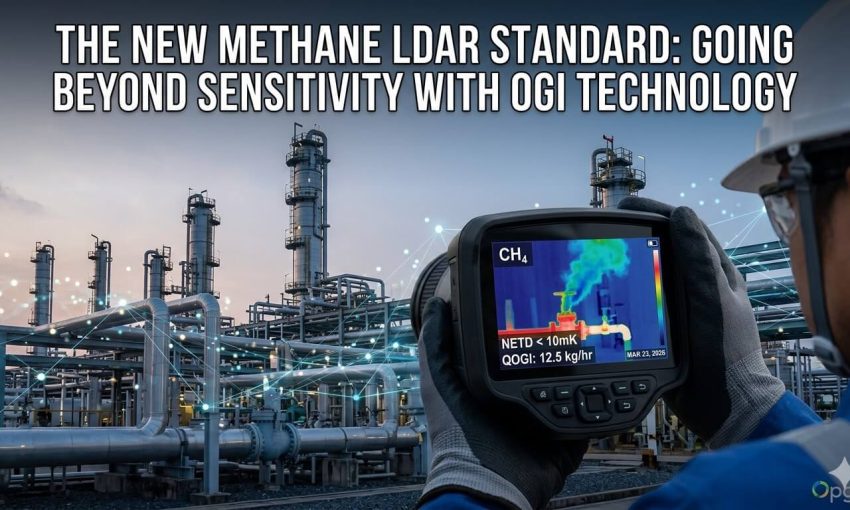
The global energy sector is facing a transformative shift in how methane ($CH_4$) emissions are monitored, reported, and mitigated. With the U.S. Environmental Protection Agency (EPA) finalizing OOOOb/c standards and the European Union implementing stringent new methane regulations, the industry is moving from voluntary leak detection to mandatory, high-precision quantification. For operations managers and field engineers, the central question is no longer whether to use optical gas imaging cameras, but rather which level of sensitivity is required to remain compliant and profitable. This guide explores the technical evolution of LDAR, the critical importance of Noise Equivalent Temperature Difference (NETD) below 10mK, and how camera leak detection is delivering a proven Return on Investment (ROI) in an era of “Super Emitters” and methane waste charges.
The Regulatory “Perfect Storm”: From OOOOa to the OOOOb/c Era
For nearly a decade, the industry operated under NSPS OOOOa, which primarily targeted new or modified sources and relied heavily on legacy detection methods. As we progress through 2026, the landscape has fundamentally changed. The introduction of EPA OOOOb (for new sources) and OOOOc (the first federal guidelines for existing sources) represents a 400% increase in the scope of regulated infrastructure.
The Rise of the “Super Emitter”
One of the most disruptive elements of the current regulatory framework is the Super Emitter Response Program (SERP). This program empowers certified third parties—using satellites and aerial flyovers—to report large methane releases (exceeding 100 kg/hr) directly to the EPA. Once reported, operators are legally mandated to investigate and remediate within strict timeframes.
This “open-source” enforcement model means companies can no longer rely on internal schedules. They must possess robust, high-sensitivity OGI systems ready for immediate deployment to verify or debunk third-party claims. The burden of proof has shifted entirely to the operator, making the accuracy of their methane camera a matter of legal and financial survival.
Technical Comparison: Legacy “Sniffers” vs. Modern OGI Systems
To understand the current dominance of thermal imaging leak detection it is essential to compare it to the legacy standard: EPA Method 21, which utilizes Flame Ionization Detectors (FID) or “sniffers.”
Manual Point-Sampling (Method 21)
Method 21 is a contact-based approach. A technician must physically place a probe at every potential leak point—every flange, valve, and seal.
- The Labor Trap: In a medium-sized facility with 10,000 components, a full survey can take weeks of manual labor.
- Safety Risks: Technicians must often climb scaffolding or enter hazardous zones to reach high-altitude connectors.
- The “Zero-PPM” Illusion: Sniffers only detect what is directly in front of the probe. If a leak is occurring 5 centimeters away or blowing in the opposite direction, the device will record zero emissions, creating a dangerous “false negative.”
Optical Gas Imaging (OGI)
Optical gas imaging cameras operate on the principle of infrared spectral absorption. By visualizing gas plumes in real-time, OGI offers a “top-down” view of facility health.
- Efficiency: An OGI operator can scan hundreds of CH4 connections in the time it takes a Method 21 technician to check five.
- Contextual Intelligence: OGI does more than find a leak; it identifies the source. It distinguishes between a leaking seal (maintenance required) and a designed vent (operational normality), preventing unnecessary shutdowns.
- Remote Detection: Operators can scan high-risk or hard-to-reach assets from a safe distance, significantly reducing the Man-Hours per Survey (MHPS).
The Science of Sensitivity: Why NETD < 10mK is Non-Negotiable
In the world of thermal imaging leak detection, the most critical specification is NETD (Noise Equivalent Temperature Difference). This value determines the smallest temperature difference the camera can distinguish.
Understanding Thermal Contrast
OGI cameras do not “see” gas molecules; they see the energy the gas absorbs. Methane absorbs infrared radiation at a specific wavelength (typically around 3.2–3.4 $\mu m$). To visualize a leak, there must be a “thermal contrast” between the gas and the background (the sky, a tank wall, or the ground).
The Performance Gap: 25mK vs. 10mK
- Standard OGI Cameras (25mK+): These cameras perform adequately in perfect conditions (high sun, high contrast). However, in “low-delta T” environments—such as cloudy days, early mornings, or when the gas temperature matches the ambient temperature—a 25mK camera becomes effectively “blind” to smaller leaks.
- High-Definition OGI (NETD < 10mK): A camera with sensitivity below 10mK can distinguish minute thermal variations. This allows the operator to see “ghost plumes”—small, low-pressure leaks that aggregate into significant volume over time.
For an HSE manager, the difference between 25mK and 10mK is the difference between finding 60% of leaks and finding 99% of them. In the context of EPA Appendix K, which mandates specific performance standards for OGI, high sensitivity is the only way to ensure full regulatory compliance.
From Qualitative to Quantitative: The QOGI Revolution
Historically, OGI was a qualitative tool (answering “Is there a leak?”). To know the mass flow rate (e.g., kg/hr), operators still had to return to sniffers or high-volume samplers. The emergence of Quantitative Optical Gas Imaging (QOGI) has changed this.
The Financial Impact of the Methane Waste Charge
Under the Inflation Reduction Act’s Methane Emissions Reduction Program (MERP), the cost of methane emissions is now a direct line item on the balance sheet. Starting at $900 per metric ton in 2024 and rising to $1,500 per metric ton by 2026, the “cost of doing nothing” is exorbitant.
Data-Driven Maintenance Prioritization
By using an OGI system with built-in quantification, operations teams can move from “guessing” to “measuring.”
- Mass Flow Identification: The system calculates the mass flow of a leak in real-time.
- ROI-Based Repair: A leak of 15 kg/hr is prioritized for immediate repair, while a 0.05 kg/hr leak is scheduled for the next turnaround.
- Empirical Reporting: Instead of using “population-based emission factors” (which often overestimate emissions), companies can report empirical data to regulators, potentially saving millions in over-calculated waste charges.
Operational Excellence: Intrinsically Safe (IS) Design and Speed
The highest-performing ogi systems are those that can be used without disrupting the facility’s workflow. This is where Intrinsically Safe (IS) certification becomes a critical factor for camera leak detection.
Eliminating the “Hot Permit” Delay
In most refineries and offshore platforms, using standard electronic equipment in a Zone 2 or Class I Div 2 area requires a “Hot Permit”—a complex administrative process that involves safety standbys and localized shutdowns.
- IS Certified Cameras: Cameras engineered for intrinsic safety can be taken directly into the “hot zone” without a permit.
- Continuous Workflow: An inspector can move seamlessly from the perimeter to the heart of a compressor station, scanning components as they go. This reduces survey time by up to 50% by eliminating administrative friction.
The “Digital Twin” of Compliance
Modern OGI technology does not just capture images; it captures data. High-end systems now integrate:
- GPS Tagging: Every leak is geolocated.
- Time-Stamping: Critical for Appendix K record-keeping.
- Cloud Integration: Real-time upload of leak data to an asset management system, allowing the maintenance team to receive repair orders before the inspector even leaves the field.
Continuous Monitoring: The Sentinuum24 Model
While handheld optical gas imaging cameras are essential for quarterly surveys, the industry is moving toward 24/7 automated intelligence. A leak that starts on Tuesday and isn’t detected until a quarterly survey in two months can result in massive product loss and a “Super Emitter” event.
AI-Driven Fixed OGI
Fixed OGI solutions, such as the Sentinuum24, use the same high-sensitivity sensors (<10mK) but are mounted on pan-tilt units and controlled by AI.
- Autonomous Detection: The AI distinguishes between steam/fog and actual hydrocarbons, preventing “alarm fatigue.”
- Zero Blind Spots: Constant scanning of high-risk assets like tank batteries and compressor seals.
- Instant Mitigation: The system can be integrated into SCADA, allowing for remote valve shut-off the moment a major leak is detected.
Future-Proofing Your Facility for 2026 and Beyond
Methane compliance in the current era is no longer a “check-the-box” exercise. With the financial penalties of Subpart W and the public scrutiny of the Super Emitter program, the cost of “average” technology has become prohibitively high.
The strategic shift to OGI systems with thermal sensitivity below 10mK represents the most effective way to protect a facility’s reputation and bottom line. By investing in high-definition, quantitative, and intrinsically safe technology, operators are doing more than just meeting a regulation—they are gaining total visibility over their assets.
The era of invisible leaks is over. With modern OGI, the invisible is now quantified, managed, and mitigated.