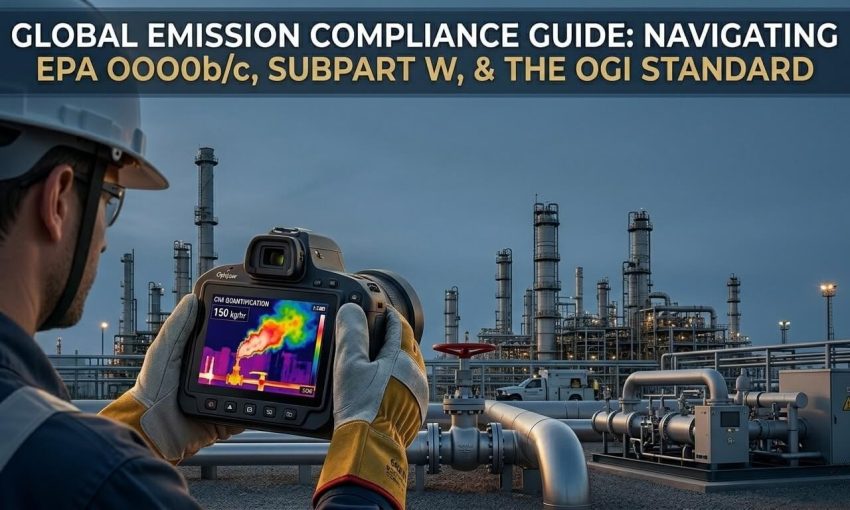
The global energy sector is facing an unprecedented regulatory “perfect storm.” As of 2024 and heading into 2026, the transition from voluntary leak detection to mandatory, high-precision quantification is no longer a future projection—it is an operational reality. With the U.S. Environmental Protection Agency (EPA) finalizing the OOOOb and OOOOc standards, and the European Union implementing its own stringent Methane Regulations, the burden of proof has shifted to the operator. This guide explores how Optical Gas Imaging (OGI) technology has evolved from a diagnostic tool into the central pillar of global regulatory compliance.
The Regulatory Shift: From NSPS OOOOa to the OOOOb/c Era
For nearly a decade, NSPS OOOOa served as the primary framework for the oil and natural gas industry. However, it was largely focused on new or modified sources. The introduction of EPA OOOOb (for new, modified, and reconstructed sources) and OOOOc (the first-ever federal emission guidelines for existing sources) represents a 400% increase in the scope of regulated infrastructure.
The “Super Emitter” Response Program (SERP)
Perhaps the most disruptive element of the new EPA framework is the Super Emitter Response Program. Under this rule, the EPA has authorized certified third parties—utilizing satellite data, aerial flyovers, and remote sensing—to identify large methane releases (exceeding 100 kg/hr).
Once a “Super Emitter” event is reported to the EPA, the operator is legally mandated to investigate and report back within a strict timeframe. This “open-source” enforcement model means that companies can no longer rely on internal schedules for leak detection; they must have a robust, high-sensitivity methane detection camera strategy ready to deploy at a moment’s notice to verify or debunk third-party claims.
Appendix K: The Technical Blueprint for OGI Compliance
The EPA’s Appendix K is the most significant technical document produced for the Leak Detection and Repair (LDAR) industry in decades. It moves OGI from a “best practice” to a strictly regulated protocol. Compliance with OOOOb/c is predicated on following Appendix K, which dictates every aspect of how a gas imaging camera must be used in the field.
Equipment Performance Requirements
Appendix K does not recognize all thermal cameras as equal. It mandates specific performance criteria, including:
- Response Factor: The camera must be proven to detect specific gas compounds under varying thermal contrasts.
- Detection Sensitivity: The system must be capable of identifying minute leaks that were previously overlooked by traditional Method 21 “sniffers.”
- Documentation: Every survey must be digitally recorded and archived, creating a “digital twin” of the facility’s compliance history.
Opgal’s EyeCGas Multi was engineered specifically to exceed these requirements. With a Noise Equivalent Temperature Difference (NETD) of <10mK, it is the most sensitive handheld OGI camera on the market, ensuring that even the smallest leaks—which could aggregate into a major compliance failure—are captured and documented.
Subpart W and the Methane Waste Charge
While OOOOb focuses on the “how” of detection, Subpart W (under the Greenhouse Gas Reporting Program) focuses on the “how much.” Recent updates to Subpart W have eliminated many of the “generic emission factors” that allowed companies to estimate their footprint based on equipment counts.
The Financial Impact of MERP
Under the Inflation Reduction Act (IRA), the Methane Emissions Reduction Program (MERP) introduces a “Waste Emissions Charge.” Starting at $900 per metric ton of methane in 2024 and rising to $1,500 by 2026, the financial cost of unquantified leaks is now a direct hit to the bottom line.
Using an OGI system with built-in quantification (QOGI) capabilities, like those found in the Opgal ecosystem, allows operators to move from “population-based estimates” to “empirical measurement.” By quantifying the mass flow of a leak in real-time, HSE managers can prioritize repairs based on the actual financial and environmental impact, rather than guesswork.
The Operational Advantage of Intrinsically Safe (IS) Design
In the high-stakes environment of a petrochemical plant or offshore rig, the greatest enemy of efficiency is the “Hot Permit.” Traditional electronic equipment requires a facility-wide safety shutdown or a complex permitting process to operate in hazardous areas (Zone 2/Class I Div 2).
Eliminating the “Hot Permit” Delay
A non-intrinsically safe leak detection camera can turn a simple 20-minute inspection into a 4-hour administrative ordeal. Opgal’s commitment to Intrinsically Safe certification means that the EyeCGas series is built to operate in the heart of the “hot zone” without additional safety measures.
- Safety: Zero risk of the camera acting as an ignition source.
- Speed: Inspectors can move freely across the facility, significantly increasing the number of components scanned per day.
- Cost-Efficiency: Reducing the man-hours required for LDAR surveys directly lowers the operational cost of compliance.
Continuous Monitoring: The Sentinuum24 Revolution
The industry is beginning to realize that periodic “campaign-based” inspections (once per quarter or once per year) are insufficient for the “Super Emitter” era. A leak that starts one day after a manual survey can bleed thousands of dollars in gas and fines before the next scheduled check.
AI-Driven 24/7 Automated Intelligence
The Sentinuum24 fixed OGI solution represents the pinnacle of OGI technology. By combining Opgal’s world-renowned infrared sensors with advanced AI analytics, the system provides:
- Zero Blind Spots: Constant monitoring of critical assets (compressor stations, tank batteries).
- Autonomous Alerts: The AI distinguishes between steam/fog and actual gas leaks, reducing “false alarms” that plague lower-end systems.
- Real-Time Data Integration: Feeds directly into SCADA systems, allowing for immediate remote shut-off if a major leak is detected.
Global Standards: Beyond the US Borders
While the EPA sets the pace for North America, the EU Methane Regulation and the OGMP 2.0 (Oil & Gas Methane Partnership) framework are defining the global standard. Organizations operating internationally must harmonize their fleets to meet the highest common denominator of regulation.
Opgal’s products are marketed in over 60 countries, ensuring that the data captured in the Permian Basin is just as valid and compliant as the data captured in the North Sea or the Middle East. With multi-spectral filters capable of detecting Methane (CH4), CO2, and over 400 VOCs, Opgal provides a unified platform for global environmental stewardship.
Choosing a Partner, Not Just a Vendor
Compliance in the OOOOb/c and Subpart W era is not a “check-the-box” exercise. It is a continuous commitment to accuracy, safety, and transparency. As regulatory scrutiny intensifies, the cost of “average” technology becomes prohibitively high—measured in fines, lost product, and reputational damage.
At Opgal, our 40 years of innovation have been dedicated to one goal: seeing the invisible threats that others miss. From the handheld precision of the EyeCGas Multi to the automated vigilance of Sentinuum24, we provide the optical gas imaging solutions that turn regulatory challenges into a competitive advantage.
Future-Proof Your Facility
The transition to OOOOc and the full implementation of Subpart W reporting is rapidly approaching. The time to upgrade your LDAR infrastructure to the Appendix K standard is now. Ensure your team is equipped with the world’s most sensitive, rugged, and compliant OGI technology.
Opgal: Beyond the Visible.