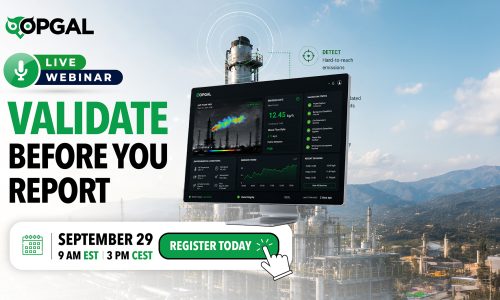

Join Opgal for an exclusive look at new EyeQGas. The next evolution in Optical Gas Imaging. Learn how autonomous quantification eliminates human error, filters out fluctuating environmental conditions, and automatically validates plume data to deliver fully defensible, audit-ready emission reports for EPA and OGMP 2.0 compliance.
Quantitative Optical Gas Imaging (QOGI) has transformed how energy and chemical operators detect and measure emissions. However, generating accurate, compliant emission estimates in real-world conditions remains a major challenge. Shifting cloud cover, shifting wind vectors, improper lens selection, and operator siting errors can severely skew emission calculations. Leaving companies vulnerable during audits.
Even the most experienced field technicians face variables that are nearly impossible to account for manually. That is where the next evolution of QOGI begins.
In this webinar, we introduce EyeQGas, Opgal’s autonomous QOGI validation platform designed to bring absolute confidence to emissions monitoring. Discover how our unique algorithm, and AI vision automatically verifies environmental parameters, validates plume capture before reporting, and provides real-time feedback to overcome field noise and human error.
Whether you are navigating EPA/EU Standards or striving for OGMP 2.0 Gold Standard compliance, this session will provide actionable insights on transforming raw thermal inspection data into defensible, audit-proof emission reports.
What You Will Learn
- The Hidden Pitfalls of Field QOGI: How background shifts (clouds, thermal reflection), wind speeds, and operator siting mistakes impact measurement accuracy.
- How EyeQGas Validation Works: Live breakdown of how the platform automatically confirms plume capture, verifies air temperature, and corrects for atmospheric concentration-length variables.
- Standardizing Field Operations: How built-in operator feedback and automated screening reduce skill gaps across field inspection crews.
- Audit-Ready Compliance: Delivering validated emission rates and transparent uncertainty calculations that meet evolving global regulations.
View the webinar in this link: