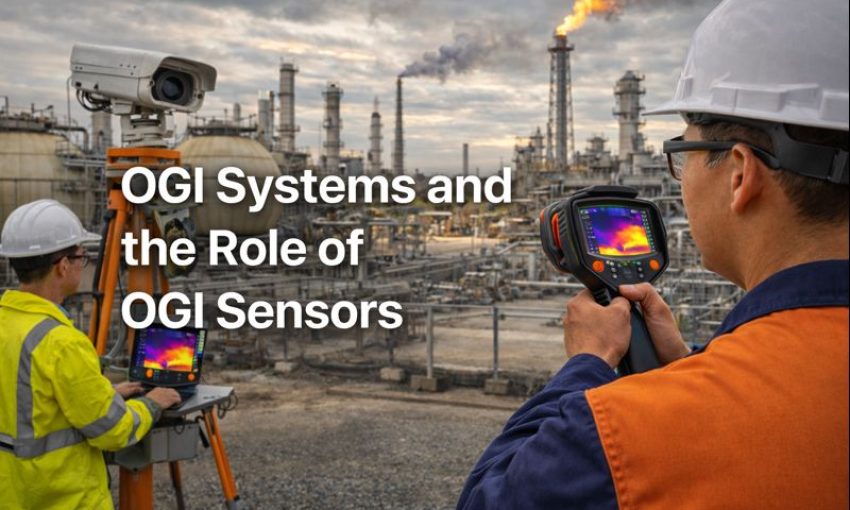
Introduction: Why OGI Systems Are Becoming an Industry Standard
Industrial gas detection is undergoing a fundamental shift. As safety, environmental accountability, and regulatory oversight continue to intensify, operators are moving away from isolated measurement tools toward integrated detection platforms. OGI systems represent this evolution by combining optical gas imaging with intelligent data workflows that support continuous monitoring, verification, and reporting.
At the core of these systems lies the OGI sensor, the component responsible for capturing gas signatures and transforming invisible emissions into actionable data. Together, OGI systems and sensors form a comprehensive solution that supports operational safety, compliance, and long-term asset integrity.
What Are OGI Systems?
OGI systems are integrated gas detection platforms designed to visualize and monitor gas emissions across industrial environments. Unlike standalone cameras or portable tools, OGI systems combine multiple components into a unified operational framework.
Typical elements of OGI systems include:
-
Optical gas imaging hardware
-
One or more OGI sensors tuned to specific gases
-
Data processing and analytics software
-
Storage and reporting interfaces
-
Connectivity for remote monitoring or centralized control
This system-level approach allows organizations to move from periodic inspections to structured, repeatable detection programs.
The Function of an OGI Sensor
An OGI sensor is the technical foundation of any OGI system. It detects specific gas absorption characteristics within the infrared spectrum and converts them into visual or digital signals.
Key characteristics of OGI sensors include:
-
Spectral sensitivity to target gases
-
High signal-to-noise performance
-
Thermal stability under industrial conditions
-
Calibration consistency over time
The quality of the OGI sensor directly affects detection accuracy, false positive rates, and the ability to operate in challenging environments.
How OGI Sensors Integrate into OGI Systems
Within OGI systems, the sensor does not operate in isolation. It feeds raw detection data into software layers that enhance interpretation and usability.
Integration typically enables:
-
Real-time visualization of emissions
-
Automated event detection and flagging
-
Time-stamped data capture for audits
-
Comparison against historical baselines
-
Export of data for compliance workflows
This integration is what transforms a sensor into a scalable operational tool rather than a single-use instrument.
Applications of OGI Systems Across Industries
Oil and Gas Operations
OGI systems are widely used across upstream, midstream, and downstream assets to detect fugitive emissions, monitor valves and compressors, and verify repairs. The use of high-performance OGI sensors enables detection from safe distances, reducing exposure risk.
Chemical and Petrochemical Facilities
In chemical plants, leaks may involve hazardous or corrosive gases. OGI systems provide non-contact monitoring that supports early detection and process safety management.
Power Generation and Utilities
OGI systems help identify leaks in fuel delivery systems, turbines, and auxiliary equipment. Sensors designed for stability in high-temperature environments are critical in these applications.
Manufacturing and Industrial Processing
Facilities that rely on compressed gases or controlled atmospheres use OGI systems to improve efficiency, reduce losses, and maintain consistent operating conditions.
Advantages of System-Based OGI Detection
Compared to standalone detection tools, OGI systems deliver measurable operational benefits.
Key advantages include:
-
Broader coverage with fewer inspections
-
Consistent detection standards across sites
-
Reduced dependence on manual interpretation
-
Improved documentation and traceability
-
Faster response to emerging leaks
The presence of reliable OGI sensors ensures that system outputs remain accurate and defensible.
Reliability, Calibration, and Long-Term Performance
For OGI systems to remain effective, sensor performance must be stable over time. Drift, thermal noise, or environmental interference can reduce detection reliability if not properly managed.
High-quality OGI sensors are designed with:
-
Robust calibration methodologies
-
Resistance to temperature and humidity variation
-
Long operational lifecycles
-
Minimal recalibration requirements
These characteristics are essential for facilities operating under regulatory scrutiny or continuous monitoring programs.
Supporting Compliance and ESG Objectives
OGI systems increasingly play a role in regulatory compliance and ESG reporting. Visual evidence, sensor data, and automated logs support transparent reporting and internal accountability.
By integrating OGI sensors into structured workflows, organizations gain:
-
Stronger audit readiness
-
Verifiable detection records
-
Alignment with evolving environmental standards
-
Improved emissions management strategies
From Detection to Decision Making
Modern OGI systems do more than identify leaks. They enable informed decision making by linking sensor data with operational context. This allows teams to prioritize repairs, allocate resources efficiently, and reduce risk proactively.
As gas detection strategies evolve, the combination of advanced OGI systems and high-performance OGI sensors is becoming a defining factor in industrial safety and environmental stewardship.
From Detection to Control: Why OGI Systems Are the New Industry Baseline
OGI systems represent the next stage of industrial gas detection. By integrating reliable OGI sensors into scalable platforms, organizations gain visibility, control, and confidence across their operations.
In an environment where emissions accountability is no longer optional, system-based optical gas imaging provides the foundation for smarter, safer, and more sustainable industrial performance.
Frequently Asked Questions About OGI Systems
What are OGI systems used for?
OGI systems are used to detect, visualize, and document gas emissions in industrial environments using optical gas imaging technology.
What is an OGI sensor?
An OGI sensor is the component within an OGI system that detects specific gas signatures in the infrared spectrum and converts them into visual data.
How do OGI systems differ from standalone gas cameras?
OGI systems integrate sensors, analytics, and reporting tools, while standalone cameras rely more on manual operation and interpretation.
Are OGI systems suitable for continuous monitoring?
Yes. Many OGI systems support continuous or high-frequency monitoring depending on sensor configuration and operational needs.
Do OGI systems support regulatory compliance?
Yes. They provide visual evidence, data logs, and documentation that support safety and environmental compliance programs.